It wasn’t just a show: it was a cultural inventory
Bad Bunny’s halftime show, told from here. A detailed analysis of Bad Bunny’s halftime show as a cultural inventory: work, memory, migration, and Latin symbols—explained one by one from Puerto Rico.
ACTUALIDAD & OPINIÓN
PART 1
Origin, Language, and the Country That Worked
(with personal memory)
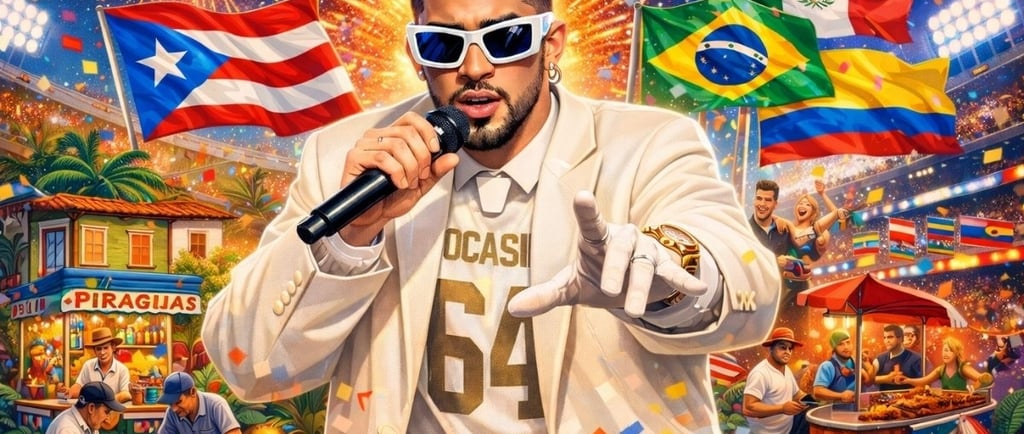
The halftime show began before Bad Bunny even appeared. And that is key to understanding it.
The first image was not a global star, nor pyrotechnics, nor spectacle. It was a jíbaro, dressed as such, standing in a sugarcane field, guitar in hand and pava on his head. That figure is neither generic nor romanticized: it is a very specific visual construction of rural, agricultural, working Puerto Rico.
The jíbaro says two things that set the tone for the entire show:
“How good it feels to be Latino.” “Tonight we drinkkkk.”
That second shout is not accidental. Although many repeat it today, the phrase “Hoy se bebe,” in its contemporary use, was popularized by Anthony Santos, a Dominican bachata singer. The detail is subtle but fundamental: the image is Puerto Rican, but the phrase is Dominican.
From the very first second, the show establishes that Latin identity is neither closed nor pure. It is not “this is PR and only PR.” It is a shared Caribbean, intertwined memory, influences moving between islands. A Puerto Rican jíbaro shouting a Dominican slogan is not a mistake: it is an early declaration that what is coming will not be compartmentalized by passports.
Language as Territory: Super Tazón
Immediately after, the words appear:
Benito Antonio Martínez Ocasio presents
The halftime
show
of the Super Tazón
Something happens here that many people overlooked. It’s not just that it’s in Spanish. It’s which Spanish… and how it looks. In Puerto Rico, and across much of Latin America, we use English terms daily: halftime, show, Super Bowl. No one needs a translation. And yet, the performance deliberately chooses to translate them. Not as an academic gesture, but as a cultural one.
Moreover, “Super Tazón” doesn’t feel strange to many of us. We first heard it on The Flintstones, in the Latin American dub, on that television we watched in Spanish. It isn’t a literal translation: it’s shared televised memory.
And that gesture is visually reinforced through the typography. The letters are not modern or sporty. They are a script-style font, cursive, elegant, very much in the style of 1980s telenovelas. Beautiful, rounded lettering—more fitting for soap opera credits than for a global sporting event. All of it communicates the same thing: if this story is going to be Latino, it will be told in our words and through our visual codes, even if they sound—or look—uncomfortable on a corporate American stage.
The Human Sugarcane Field: Work, History, and Family Memory
When Bad Bunny appears, he does so in the middle of a sugarcane field—but the field is not made of plants. It is made of people dressed as stalks, moving as part of the scenery. The countryside is not in the background; the countryside is people.
Then actors appear cutting cane, as was done in Puerto Rico when sugarcane was the country’s most important industry. This is not an abstract reference. For many families, including mine, it is direct history.
My grandfather was a foreman at Central Canóvanas, one of many sugar mills that shaped the country’s economic and social life. My mother still remembers the cane, the trains that transported it, the constant noise, the rhythm of work that structured the days.
She also remembers the laborers who came from far away to work and slept in a small wooden house my grandfather had behind their home. They were men who did not always have family nearby, who worked hard and settled wherever they could. That was normal. That was Puerto Rico.
So when the show depicts cane being cut by hand, it is not evoking some distant past. It is touching a memory that still lives in our parents’ stories.
There is no romanticism here. There is recognition.
From Sweat to Relief: The Cold Coconut
Bad Bunny steps out of the sugarcane field and encounters a cold coconut stand. This detail is fundamental because the coconut is not presented merely as a drink, but as a complete ritual—recognizable to anyone who grew up in Puerto Rico’s coastal towns:
the vendor slices open the top
places a straw inside
we drink the cold water
then the coconut is split open with a machete
we eat the “white flesh”
The vendor wears a short-sleeved t-shirt, cut high at the sleeves, very much in the style of the 1970s. It is not curated fashion or manufactured nostalgia: it is functional clothing, street clothing, heat clothing.
Here, the narrative moves from hard labor to the everyday reality of the body: how the worker cools down.
The Domino Table: Adult Community
Then four older adults appear seated at a domino table, beers in hand.
The domino game is not explained because it does not need explanation. It functions as a symbol of:
conversation
socialization
discussion and silence
shared time
generational continuity
It is not a game. It is a social space.
The Conscious Choice: The Manicurist
One of the most revealing details in the opening block is who appears working.
Among all possible trades — mechanic, tire repairman, plumber — the show chooses to present a manicurist. A woman doing another woman’s nails.
This gesture is not neutral. In Puerto Rico and in Latin culture:
nails are not luxury
they are routine
they are identity
they are female microeconomy
they are economic independence
Showing the manicurist is an acknowledgment of feminized, informal, real labor — work that sustains thousands of women and is rarely validated in official narratives.
Women Building
Then the scene shifts to a structure made of concrete blocks. Four women work with trowels, spreading cement.
The important detail is how they are presented:
they are not masculinized
they are not hidden
they are not caricatured
they look confident, feminine, and competent
The message is concrete: women do not only nurture and beautify; they also build structure.
The Piragua: Collective Rest
Then the piragua cart appears: the large block of ice, the colorful syrups, the classic scene one associates with parks, tourist areas, and Old San Juan. Bad Bunny holds a piragua in his hand.
Later we learned that the man serving the piragua is not an extra or an actor. He is Juan Pablo Piñeiro, a Cuban professional basketball player, very beloved in Puerto Rico, and the real owner of a piragua stand in Old San Juan.
That detail adds another layer to the scene: it is not just the typical product, it is real life blended with spectacle. A migrant athlete, integrated into the local economy, representing a traditional trade on the largest stage in American entertainment.
The Migrant Crossing: Villa’s Tacos
Walking along, Bad Bunny encounters a cart that reads Villa’s Tacos. This is not a generic taco. It is a real business owned by Víctor Villa, Mexican of Michoacán roots, born in the United States, based in Los Angeles.
In Puerto Rico there are Mexican restaurants, but the taco cart culture does not exist as it does in Mexico or California. That is why this scene does not represent the island: it represents migrant Latinidad in the United States.
Here a clear exchange takes place:
Puerto Rico brings the piragua
Mexico/LA brings the taco
the encounter happens on U.S. soil
It is the first explicit signal that the narrative is going to move beyond the island.
Boxing: Two Powers, One Respect
Then two boxers appear:
Xander Zayas (Puerto Rico)
Emiliano Vargas “El General” (Mexico)
Puerto Rico and Mexico are the two great historical powers of Latin boxing. The detail is not only that they are there, but that they are together. Bad Bunny walks beneath their raised fists. He does not compete. He does not appropriate. He acknowledges.
Compra Oro: When Love Is Pawned
The sign COMPRA ORO appears. The man behind the counter reflects an aesthetic recognizable within the Latin diaspora in the U.S.: long hair pulled back, earrings, urban NY/NJ style.
He hands Bad Bunny a small box with a wedding ring inside. This is not about jewelry.
It is about migrant sacrifice.
Reparation: The Proposal
The lyrics play along: “The day I get married I’ll send you the invitation… boy, leave that alone.”
Bad Bunny hands the ring to a young man. The young man kneels. She becomes emotional. What one generation had to pawn, another can wear again.
Closing of Part I
Up to this point, the show has not spoken about fame or success.
It has spoken about:
work
informal economy
family memory
gender
migration
reparation
None of this is decoration. It is a narrative foundation.
PART II
The Little House, the Body, and the Moment Everything Changes
After the initial journey through work, the street, and different trades, Bad Bunny keeps walking. The camera stops jumping between vignettes and chooses to follow him. We are no longer watching isolated scenes: now there is continuity.
In front of him appears the little house (la casita). It is complete, visible from the outside. It stands there as structure, as familiar façade. The audience recognizes it from his concerts, but here we are not yet allowed to see inside.
Bad Bunny moves around it. The camera stays outside.
In Front of the House: The Dancers
Then, in front of the little house, the dancers enter. They begin to dance perreo. It is not improvised. It is clearly choreographed, designed for the camera, for a stadium, for broadcast television.
They are all women. They dance uninhibited, confident, sensual. There is no exaggerated vulgarity, no explicit contact. It is spicy, yes, but measured. It is not chaotic.
As this unfolds, one understands without anyone saying it: the female body is on stage by its own decision, not as someone else’s accessory. The song speaks about perrear sola, and the body confirms it.
The camera moves closer to the little house, but it does not enter. It only lets us see that there is life around it. Familiar faces can be distinguished — Pedro Pascal, Cardi B, Karol G, Jessica Alba, Young Miko — as part of the environment, as guests surrounding the structure, not as the protagonists of the moment.
Everything is still happening outside.
Bad Bunny Climbs to the Roof
Then Bad Bunny climbs onto the roof of the little house. The camera shifts angle and captures him from above. It is a clear shot: he is literally on top of the house.
There he says a short phrase. First in Spanish and then one word in English:
“Aprovecha que estoy soltero… single.”
It is not a shift in the language of the performance. It is a brief, almost playful wink. Spanish is still leading.
The Roof Opens
Immediately after, the roof opens. Not slowly. It opens like a stage trap. And Bad Bunny falls inside the little house. This is the first moment we see the interior.
Now Yes: Inside There Is a Family
The camera enters with him. And what we see is not backstage or an abstract set. It is a living room. A family. People of different ages seated the way real families sit.
At that exact moment — and this was pointed out to me by a reader (Rosa Zaa), rightly so — we hear an “ehh mamá, ehh mamá,” an echo that evokes Celia Cruz. It is not decorative sound. Celia represents the migrant Caribbean, salsa as identity, and the female voice that became global without ceasing to be Latina. That it plays just as we enter the interior of the home expands the scene: the house we are seeing is not only Puerto Rican; it is Latin American.
The interior is decorated in a recognizable way:
A china cabinet with decorative plates, the kind meant to be looked at, not used daily.
On top of the cabinet, a Virgin Mary, placed the way it is placed in many homes: constant presence, not a speech.
On the wall, a painting of the Puerto Rican countryside with a flamboyán tree. For many, that type of painting is simply traditional décor. For me, it has a proper name. In my grandparents’ house there were always landscapes like that, and I only ever read a signature in the corner: Cajiga. I did not know who he was. I only knew that those colors — the intense red of the flamboyán, the colonial façades, the Caribbean light — were part of the permanent backdrop of the house.
Years later I learned that Luis Germán Cajiga (1934–2025) was one of the most recognized Puerto Rican painters and printmakers, known for his vibrant landscapes of Old San Juan and his representations of criollo culture. What for me had been a “grandparents’ painting” was, in reality, part of the country’s artistic tradition.
That is why the flamboyán on the wall is not a prop. It is domestic memory turned into symbol.
There is no explanation. The camera does not underline anything. It simply allows us to look.
Bad Bunny Stands and Walks Toward the Door
Bad Bunny stands up from the floor, looks around briefly, and walks toward the door. He does not stay interacting with the family. He does not sit. He does not speak. The moment is short and direct.
When he reaches the door, he kicks it open from the inside to step out.
The gesture is strong and clear. The door does not open gently. It opens with authority. It is not someone entering by force. It is someone leaving.
Outside, the Music Changes
As he steps out, the music makes an abrupt transition. Suddenly, songs that are not Bad Bunny’s begin to play. Recognizable fragments are heard:
Tego Calderón – Pa’ Que Se Lo Goce
Don Omar – Dale Don Dale
Daddy Yankee – Gasolina
Bad Bunny keeps moving while those songs play. He does not sing. He does not take center stage.
He Walks to the Rhythm of Others
Something important happens here: he places those songs on the largest stage in American entertainment as an act of recognition. He is saying, without saying it, that before him there was impact. That there were pioneers. That there were moments that opened doors.
He does not try to outshine them or reinterpret them. He does not layer his voice over theirs. He simply lets them play.
In an industry where history is often rewritten as if it begins with the artist of the moment, this gesture functions as a living archive. It is a way of saying: I am here because they were here first.
The Dance Returns, Now with Men and Women
After that transition, dance takes center stage again. This time men and women dance together. It is still perreo, but choreographed, elevated, designed for the camera. There are no explicitly intertwined bodies. There is no voyeurism. It is sensual, yes, but contained. It demonstrates that dance can be provocative without being vulgar.
Suddenly, everything stops. The music cuts. The dancers turn and look toward the stadium screen.
The Sapo Concho Appears
On the screen, for just a few seconds, Sapo Concho appears, seated, watching the spectacle, joyful. It is not explained. It is not translated. It appears and disappears. If you understand, you understand. If you don’t, the show moves on.
Violins
The scene shifts again. The first notes of violins are heard and the melody is immediately recognizable: they begin to play MONACO. Many violinists appear, all dressed in formal attire. A conductor leads them from the front; on his lapel he wears a maga flower.
To direct the orchestral string section that sustains the introduction of MONACO, Bad Bunny brought in Giancarlo Guerrero, a conductor born in Nicaragua, raised in Costa Rica, and current music director of the Nashville Symphony, winner of six Grammy Awards. Guerrero appears on stage conducting the musicians — an unexpected and powerful gesture that merges symphonic tradition with contemporary urban music.
The violinists emerge from a set design that once again recalls the sugarcane fields, connecting classical music with the origin of the narrative. The song, already known for its European sample, is now presented elevated, carried by strings, without losing its urban pulse.
As MONACO plays, Bad Bunny walks through a tunnel of violinists. He moves slowly. He holds a football in his hand. He walks with his eyes closed.
The Message
As he walks, he says: “My name is Benito Antonio Martínez Ocasio. And if I am here today at Super Bowl 60, it is because I never, never stopped believing in myself.”
He keeps walking. Then he opens his eyes, looks directly into the camera, very close, and adds:“You should believe in yourself too. You are worth more than you think. Trust me.”
Scene Change: A Wedding Appears
The scene shifts. Now a high platform appears, with a structure that recalls a garita of Old San Juan. There, what at first seems like just another wedding within the narrative begins to unfold.
Later we learn it was not a representation. The couple on stage was truly getting married. They had sent their invitation to Bad Bunny as part of their personal story, never imagining that the production team would contact them with an unexpected proposal:
Do you want to get married at the Super Bowl?
Before stepping onto that platform, the couple held an intimate, private ceremony off camera. What we see on stage is the closing, the public celebration, the moment shared with the community.
On the platform, an officiant says only:
“By the power vested in me, I now pronounce you husband and wife. You may kiss the bride.”
There is no long speech. No explanation. Only the necessary phrase. The couple kisses. Behind them stands a crowd, as in real weddings: family, friends, community.
The platform does not feel like a cold stage. It feels like a celebration. Like the collective closing of something that had already happened in private.
The Salsa Orchestra
Behind the couple, a salsa orchestra appears. It is not a generic ensemble. They are Los Sobrinos, the same emerging orchestra that accompanied Bad Bunny during his residency. They dress with a clear 1970s and 80s aesthetic: brown suits, blue shirts, an image that connects with classic salsa without falling into forced nostalgia. The music does not enter as background. It holds the scene, sets the rhythm of the wedding, and turns the moment into a communal celebration.
Lady Gaga Is Revealed
That movement clears the space until, at the end, Lady Gaga appears dressed in sky blue, wearing a maga flower corsage on her chest. Her lips, nails, and shoes are red. It is not a random combination nor an isolated aesthetic choice. Those colors directly reference the Puerto Rican flag according to its historic 1895 scheme: sky blue, red, and white as political and cultural codes, not merely decorative ones.
In this context, Gaga does not enter as a foreign star imposing her image. She enters visually aligned with the narrative already in motion. Her presence does not interrupt the story; it reinforces it.
The detail of the maga flower — a national symbol — in her wardrobe confirms that she is not “invited” to the show; she is integrated into it.
The audience reacts. She begins to sing Die With a Smile. The song is in English… in salsa. It is the only English-language song of the performance. But it is not performed as a pop ballad. It is performed as salsa.
Lady Gaga dances salsa. Not perfectly, not expertly, but fully immersed in the rhythm, committed.
Bad Bunny appears, takes her hand like a gentleman, and says: “While we are alive, we should love as much as we can.”
Baile Inolvidable Begins
They dance together for a moment. Then he lets her go. She moves on to dance with another dancer. Bad Bunny moves through the scene. He gives a little spin to a young girl.
The Cake
The camera moves in on the wedding cake. It is round, classic, the kind from years ago, with long staircases. The bride and groom cut an enormous slice and laugh.
The Sleeping Child
Among the crowd, Bad Bunny approaches a child sleeping across several chairs, using a football as a pillow. The music keeps playing. No one stops for him. It is a recognizable scene.
In our family gatherings, it was always like that. No one left early. The music continued. The conversation continued. And when sleep arrived, children settled wherever they could: across a row of chairs, in the hostess’s bed, among the guests’ purses stacked in a spare room. The body gave in, but the party did not fade.
Even in many Pentecostal churches it happened the same way: if the service ran long, sleepy children ended up lying under the pews, waiting for it to end.
That is why this image is so Latin. It is not neglect. It is extended community. It is belonging to a space where adults continue celebrating while the child sleeps protected by familiar noise.
Closing of the Block
Before the scene ends, Bad Bunny says: “Dance… dance without fear. Love without fear.” Then he walks toward the edge of the stage. That is where this part ends.
PART III
The Fall, the Diaspora, and the Definition of America
Bad Bunny reaches the edge of the platform. He does not announce it. He does not say goodbye. He simply stops there, looking upward. “NUEVAYOLLLLL.”
Suddenly the shout is heard: “NUEVAYOLLLLL.” And without a smooth transition, Bad Bunny lets himself fall backward. He does not fall alone. Below, many dancers are waiting, ready to catch him. The body does not crash; the body is received. From that moment on, the show definitively leaves the house and enters the diaspora.
Below: The Latin Street
Below, the scene becomes a Latin neighborhood street in New York. Several storefronts are visible. One of them reads La Marqueta.
It is not a generic or decorative name. It directly references La Marqueta in East Harlem, a real and emblematic space of the Latin diaspora. For decades it has been a gathering point for Puerto Ricans and other Latinos: a place of small merchants, food, music, conversation, and community life.
It is not an elegant or tourist market. It is a place of daily survival, exchange, neighborhood. Its presence clearly marks that we are no longer on the island: we are in the Puerto Rico that remade itself in New York.
On one of the façades, the Puerto Rican flag appears. It is not centered or lit like a tourist postcard. It is there the way flags hang in the neighborhoods: suspended, everyday.
Barbershop and Braids: The Street That Raises You
The camera moves and shows a barbershop. Inside, a barber is cutting a young boy’s hair. Outside, on the sidewalk, a woman is braiding another woman’s hair as she sits in a chair. There is no dialogue. No emphasis. It is simply the street functioning. This is not decoration: it is upbringing, identity passed from hand to hand.
“Un shot de cañita en Casa de Toñita”
When Bad Bunny sings that line, he walks toward one of the storefronts. He goes inside. And something happens that is not staged: Toñita is there. Toñita is not an actress. She is the real owner of the Caribbean Social Club, a legendary New York establishment and gathering place for the Puerto Rican community for decades. She serves him the shot. There is no exaggeration. No reverence. It is direct recognition of a woman who sustained culture when it was not profitable to do so.
The Audio of Tito Trinidad and the Gaze Toward the Past
The song continues and the audio of Félix “Tito” Trinidad enters, from the moment he defeated De La Hoya. The voice of Puerto Rican sports bursts in as historical archive, instantly recognizable to anyone who lived through that moment.
On a personal note, I confess that I have always expected to see Tito appear physically when his voice is used in these contexts. It has happened in concerts and it happens again here. We do not know whether there were attempts, whether it was considered or not, but his presence would have been an enormous emotional blow. Even so, the audio is enough to bring him fully into the scene: the victory, the pride, the country frozen in front of a fight.
At that very moment, the camera shifts scenes.
The House Watching the Grammys
We see another house. A family is watching television. On the screen, the Grammy Awards are being broadcast. Bad Bunny appears receiving the award. The scene moves: Bad Bunny approaches the child in that family.
The Grammy Changes Hands
The child stands up. Bad Bunny hands him the Grammy. The boy wears a striped polo shirt and cream-colored shorts. It is the same outfit Benito wore as a child in a well-known photograph. It is not said. It is shown.
The boy looks at the camera. He smiles. He is not “a fan.” He is him. He tells the boy: “Believe in yourself.”
Full Cut: The Puerto Rican Cuatro Enters
Everything stops. The sound changes completely. José Eduardo Santana Santiago, a young Puerto Rican wearing a pava, enters playing the Puerto Rican cuatro. Lo que le pasó a Hawaii begins to sound.
The song is not softened. It is not edited. It is direct protest.
Ricky Martin Appears
As the Puerto Rican cuatro continues carrying the melody of Lo que le pasó a Hawaii, the camera rises and Ricky Martin appears, singing the most important verse.
This is not a light song. It is not nostalgic. It is a warning.
The reference to Hawaii is not touristic. It is historical and political. Hawaii went from being an independent kingdom to a territory annexed by the United States. In the song, that history functions as a mirror for Puerto Rico: what happened there becomes an open question about identity, territory, and the future.
For those lyrics to be sung at the Super Bowl — without translation, without softening the message, shifts the tone of the show. It is no longer just a cultural inventory. It becomes a statement.
Ricky Martin does not enter as a pop guest. He appears as a generational figure who has also represented Puerto Rico on global stages. His presence does not interrupt the narrative; it reinforces it. The moment is brief, but its weight is significant. It is not explained. It is sung.
Power Poles: The Country Hanging
Suddenly, the scene shifts again. Three wooden utility poles appear, the kind that still support much of Puerto Rico’s electrical system. On top, old transformers. Around them, cables everywhere, crossing without order. A spark jumps. On each pole, a jíbaro wearing a pava hangs and dances.
They are not technicians. They are not linemen. They are jíbaros.
The image is clear and needs no embellishment: the country is literally hanging from a fragile, old, poorly maintained electrical system that constantly fails. Blackouts, voltage drops, transformer explosions… a daily reality affecting homes, businesses, and lives. And yet, the body keeps moving.
Then Bad Bunny shouts:
“Puerto Rico está bien cabr%$#.”
And El Apagón begins.
Here the music stops implying and steps forward as protest. The song does not speak in soft metaphors: it denounces neglect, precariousness, collective exhaustion.
The dancers enter in rows of four, advancing with force, like a block. It is not decorative dance. It is organized movement, almost martial, accompanying lyrics that directly point to a structural problem the country has carried for years.
Bad Bunny emerges holding the Puerto Rican flag.
The lyrics speak names, history, pride:
Carolina
A municipality in Puerto Rico widely considered the birthplace of modern reggaeton. It is not just geography; it is musical origin.
Maelo
Ismael Rivera (1931–1987), known as El Sonero Mayor. One of the most influential voices in Puerto Rican salsa, representing deep Afro-Caribbean musical roots.
Tego Calderón
Tego Calderón, a foundational figure in reggaeton and Latin hip-hop. His sound and social commentary helped define and expand the genre beyond the island.
Barea
J. J. Barea, a Puerto Rican basketball icon with 14 NBA seasons and a pivotal role in the Dallas Mavericks’ 2011 championship. At 5'10", he defied expectations in a league dominated by height.
“Primero que LeBron”
A direct reference to LeBron James, widely regarded as one of the greatest players in basketball history. The line does not diminish him; it positions Puerto Rican excellence within that same global conversation.
The song speaks of being boricua, of being Latino, of how now everyone wants to be Latino, but they do not have the battery nor the reggaetón.
Plena with Electronic Beats
The pole begins to lower. Por la mañana café, por la tarde ron enters. It is plena, but now fused with electronic music. Los Pleneros de la Cresta, the same group from the residency and the album, are there.
Flags Running
Many people run in carrying flags from different countries. It is not orderly. It is a crowd. They hand Bad Bunny a football.
The List of Countries
There is a pause. Bad Bunny says: “God bless America…”
And he begins to name countries: Chile, Paraguay, Argentina, Uruguay, Bolivia, Peru, Ecuador, Brazil, Colombia, Venezuela, Guyana, Panama, Costa Rica, Nicaragua, Honduras, El Salvador, Guatemala, Mexico, Cuba, Dominican Republic, Jamaica, Haiti, The Antilles, United States, Canada…
And then he says: “and my motherland… mi patria… Puerto Rico.”
The Ball and the Final Phrase
Bad Bunny raises the football in front of the camera. He says:
TOGETHER WE ARE AMERICA
He throws the ball to the ground. He turns toward the group accompanying him — flags, pleneros, dancers — and says: “¡Ahora sí!”
The Closing: What Was Not Said Before
Debí tirar más fotos begins. Everyone sings. “I should have given you more kisses and hugs whenever I could…” Before leaving, Bad Bunny says: “Muchas gracias.”
He pulls off the microphone. Everyone exits together.
The end.
Yes, there are fireworks. The stadium explodes in light and sound, as expected at a Super Bowl. The celebration fulfills the ritual of the event. But there is no individual heroic pose. There is no Bad Bunny alone at center claiming the moment.
The explosion belongs to the spectacle, not to ego.
Bad Bunny removes his microphone and leaves alongside the group that accompanied him: musicians, pleneros, dancers, flags. The exit is collective, just as the entire narrative was.
The closing does not feel like a triumphant farewell, but like a shared affirmation: no one arrived here alone.
Karaya Boricua
Desde PR con estilo y sin filtro. Aquí se comparte lo que suma.
Contacto
Únete a mi lista
karayaboricua@gmail.com
© 2026. All rights reserved.
Este sitio contiene enlaces afiliados. Como Amazon Associate, puedo ganar comisión por compras que califiquen.
Te suscribes si quieres. Te sales cuando quieras. Cero drama, cero spam.